Blueberries Really Are Good for Your Brain. Here Is the Science.
A cup a day has been linked to better memory and slower cognitive aging in multiple trials. What the research shows, and the easiest ways to make it a habit.
The salt stomping trend promises better sleep from standing on epsom salt. Here is what holds up, what does not, and a safer way to try it.
If your feed looks anything like ours lately, you have seen it: someone pours a bag of epsom salt onto a baking tray, stands on it barefoot for ten minutes before bed, and reports that their sleep has never been better. The ritual has a name now, salt stomping, and the videos come with an impressive list of claims. Lower cortisol. More serotonin. Inflammation drawn out through your feet.
We like a good nighttime ritual as much as anyone. So we looked at what is actually going on here, what the evidence supports, and how to get the real benefits without the parts that do not hold up (or the parts that are not worth a slip on a metal tray).
The typical salt stomping video makes some version of these promises: standing on epsom salt exfoliates your feet, pulls out inflammation, lowers cortisol, boosts serotonin through negative ion exposure, and shifts your nervous system into rest and digest mode, all in ten minutes, with zero extra time because you do it during your existing routine.
That is a lot of physiology to attribute to standing on a seasoning.
Here is the honest part, and it is more interesting than the hype: the ritual itself is doing real work, just not through the mechanisms the videos claim.
Wind down routines are one of the most reliable sleep signals we have. Your body responds to consistency. A repeated sequence of cues before bed, done in the same order at roughly the same time, helps signal that the day is ending. Sleep researchers have been recommending consistent pre sleep routines for decades, and it is standard guidance from the American Academy of Sleep Medicine. The specific cue matters less than the repetition. Standing quietly on a textured surface for ten minutes while you brush your teeth and wash your face is, functionally, a mindfulness practice attached to a routine you already keep. That is a genuinely smart design, and it is why people who try this often do notice something.
Habit stacking works. Attaching a new behavior to an existing routine is one of the best supported tricks in behavior research. The trend gets full credit here: “zero extra time” is exactly why people stick with it.
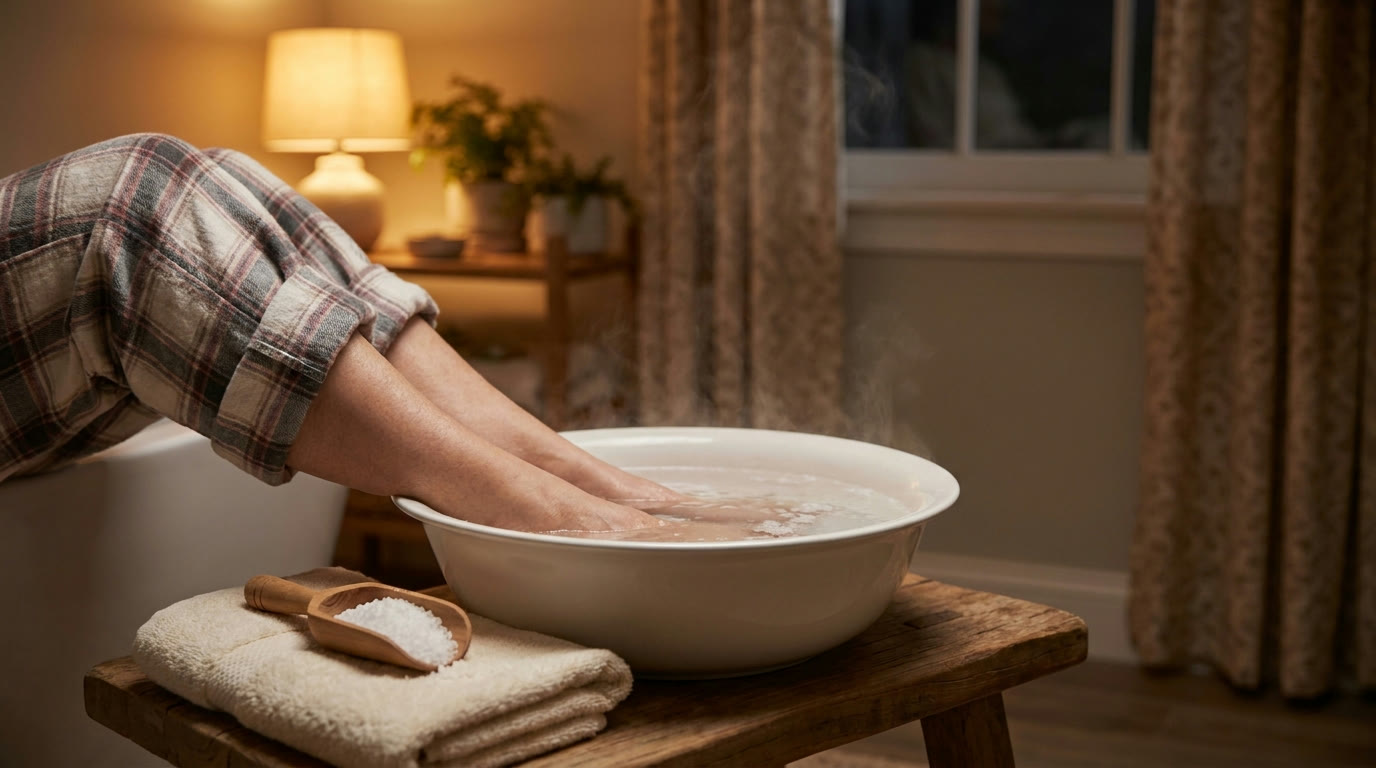
Warm water before bed has real evidence behind it. This is the part the trend skips, ironically. A 2019 meta analysis in Sleep Medicine Reviews found that warm baths or showers taken one to two hours before bed helped people fall asleep faster. Warming your skin helps your core temperature drop afterward, and that drop is one of the body’s natural sleep triggers. A warm foot soak is a gentler version of the same idea.
Salt through the skin. Epsom salt is magnesium sulfate, and magnesium does matter for sleep regulation. But a 2017 review in the journal Nutrients looked at whether meaningful amounts of magnesium are absorbed through the skin and found the evidence insufficient. If you want magnesium for sleep support, the well supported route is food: leafy greens, nuts, seeds, beans, and whole grains.
Negative ions, cortisol, and detox. There is no good evidence that standing on dry salt changes your hormone levels or draws anything out of your body. Your liver and kidneys handle that job already.
The dry stomp itself. Standing on coarse salt is essentially a texture experience for your feet. Pleasant for some people, and fine as a sensory wind down cue. But nothing about the salt being under your feet, rather than warm water around them, adds a benefit.
If the idea appeals to you, here is the version we would actually recommend, especially if you are past the age where balancing barefoot on a metal tray sounds like a good idea.
Same ritual, same zero extra time, same satisfying bag of salt. You just get the warm water evidence working for you and skip the balance risk.
If you have diabetes, neuropathy, poor circulation, or any open skin on your feet, talk to your doctor before starting foot soaks or standing on abrasive surfaces. Reduced sensation in the feet can hide irritation or injury, and that caution matters more than any nighttime ritual.
Salt stomping is a clever ritual wrapped in claims it does not need. The repetition, the wind down signal, and the habit stacking are real and useful. The warm water version has actual evidence behind it. The salt is mostly there for the satisfying pour, and honestly, that is reason enough to enjoy it, as long as you know what is doing the work.
Want more honest breakdowns of what is trending in healthy aging? That is what we do. Join the newsletter and we will send them to you.
A cup a day has been linked to better memory and slower cognitive aging in multiple trials. What the research shows, and the easiest ways to make it a habit.
These five foods have real evidence behind them for blunting glucose spikes and improving long term blood sugar control. No fad ingredients required.
Sleep gets lighter with age, but it does not have to get worse. Seven changes with real evidence behind them, ranked from easiest to hardest.